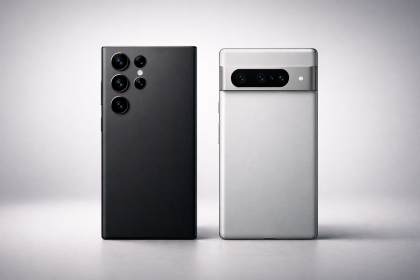

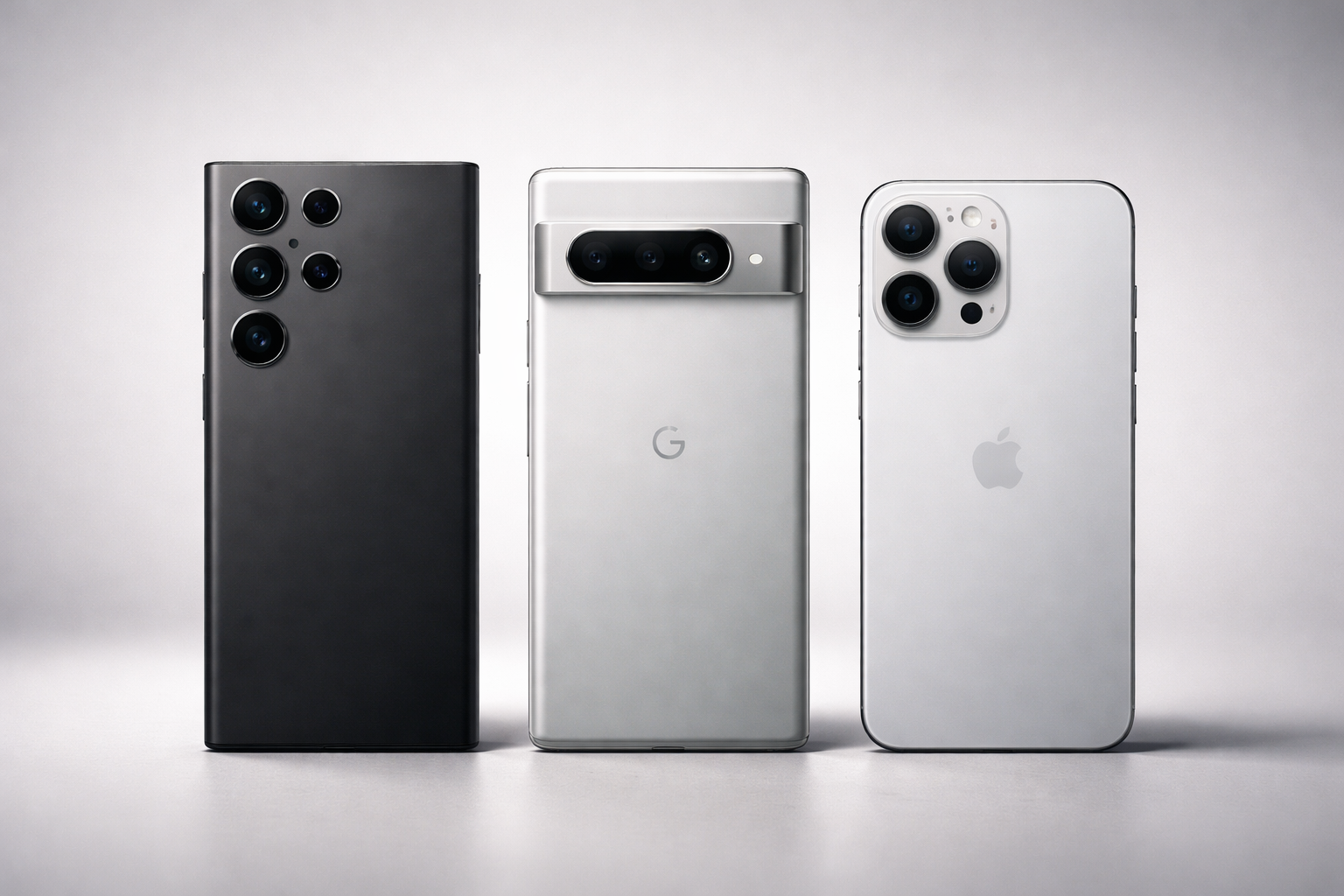
For years, the rules were simple: your phone had one assistant. Siri on the iPhone. Google Assistant on Android. Bixby, in Samsung’s case, running alongside Google’s services but never fully displacing them. The assistant was singular, system-level, and clearly defined.
That clarity is beginning to dissolve.
Samsung’s decision to integrate Perplexity AI directly into Galaxy AI — complete with its own wake phrase — signals something larger than a feature expansion. According to Samsung’s official announcement outlining the expansion of its “multi-agent ecosystem” (Samsung Newsroom), the company is deliberately moving toward an architecture where multiple AI systems can coexist inside the same device.
This is not a cosmetic change. It redefines how intelligence is structured at the operating system level.
From Assistant to Orchestrator
The traditional assistant model assumed that one AI handled everything: search, device control, reminders, translation, summaries. But as large language models diversified, specialization became unavoidable. Some systems excel at citation-backed research. Others at real-time reasoning. Others at on-device responsiveness.
Samsung appears to be acknowledging this reality rather than resisting it. Reporting from The Verge highlights that Perplexity will operate alongside existing assistants rather than replace them. The implication is clear: Galaxy AI is evolving into a coordination layer.
In that model, the assistant is no longer a personality. It becomes infrastructure.
Google’s Vertical Play
Google, by contrast, is consolidating. With the Pixel 8 series, the company introduced Gemini Nano running directly on-device for select tasks (Google Pixel 8 Pro announcement). The message was subtle but firm: Google wants the AI layer to remain vertically integrated.
Gemini is not just a chatbot; it is being positioned as the intelligence fabric of Android. The tighter the integration, the more cohesive the experience — and the stronger Google’s control over updates, data flows, and optimization.
Samsung’s multi-agent direction quietly challenges that centralization. By opening space for alternative AI systems at a system-adjacent level, it reduces dependence on a single provider.
Apple’s Controlled Evolution
Apple’s trajectory looks different again. At WWDC 2024, the company introduced what it calls “Apple Intelligence,” emphasizing on-device processing and privacy-first architecture (MacRumors coverage of Apple Intelligence). Rather than inviting multiple AI vendors into iOS, Apple is embedding generative features directly into its own ecosystem.
This is consistent with Apple’s long-standing philosophy: intelligence should feel invisible, cohesive, and tightly managed. There is little indication that iOS will evolve into an open multi-agent marketplace.
In other words, while Samsung experiments with plurality and Google consolidates vertically, Apple reinforces controlled integration.
The Real Competitive Layer
What is emerging is not just an assistant war. It is a contest over orchestration.
Who decides which AI handles which task? Who mediates conflicts between models? Who owns the routing logic?
In a multi-agent environment, the orchestration layer becomes strategically powerful. It determines defaults. It shapes user trust. It controls permissions and data boundaries. Samsung appears to be positioning Galaxy AI as that mediator.
The risk, of course, is complexity. Multiple wake words, overlapping capabilities, inconsistent tonal responses — these could fragment the user experience if poorly executed. The promise of flexibility must be balanced against cognitive load.
What This Means for Users
In practical terms, users may begin to notice specialization. A research-heavy query might be better handled by a citation-based AI system. A quick device command might default to a system-native assistant. A generative image edit might invoke a separate model optimized for visual tasks.
The assistant stops being singular and becomes situational.
This evolution also shifts how we evaluate smartphones. The question is no longer “Which assistant is better?” but “How intelligently does the device coordinate its intelligence?”
Where This Is Heading
The assistant used to be a feature buried in settings. It is now becoming the logic layer that defines how the device behaves.
Samsung’s multi-agent move suggests that smartphones are entering an orchestration era. Google’s Gemini integration reflects a consolidation era. Apple’s Apple Intelligence signals a privacy-centric internalization era.
All three approaches are rational. All carry trade-offs.
The decisive factor will not be the number of models available, nor even benchmark performance. It will be coherence. The platform that integrates intelligence without exposing its seams will likely shape the next phase of mobile computing.
The assistant is no longer a voice in your phone. It is becoming the operating principle behind it.