


A significant number of iPhone users are still reluctant to install iOS 26, despite Apple having already released multiple updates to address early complaints. According to a new study, roughly one in five users with compatible devices have chosen not to upgrade—at least for now.
While slower adoption compared to previous iOS versions was already evident, new data sheds light on why users are holding back, and the reasons go beyond the usual performance and battery concerns.
Study Highlights Growing Resistance to iOS 26
The findings come from a recent survey conducted by SellCell, which questioned around 2,000 iPhone users. Although the sample size is relatively modest, the results offer useful insight into user sentiment.
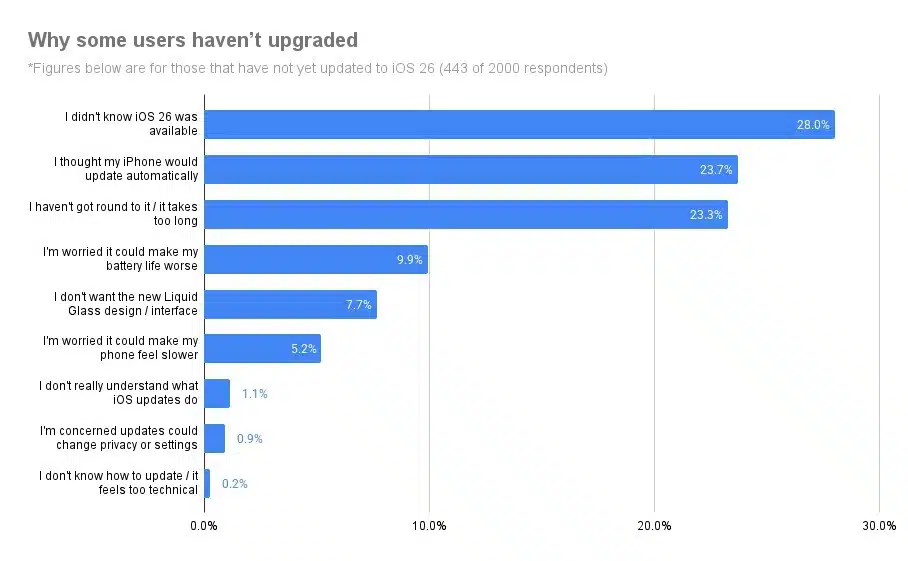
According to the study, 22% of respondents said they had not yet installed iOS 26, even though their iPhone supports the update. While this figure alone is not dramatically high, the motivations behind the delay are more revealing.
Interestingly, 28% of those users said they were not even aware that iOS 26 had already launched, despite it being available for several months. But among those who were aware, opposition to iOS 26's new design played a major role.
Liquid Glass Design Sparks Mixed Reactions
One of the most controversial changes in iOS 26 is Liquid Glass, Apple's new visual design language introduced across its operating systems. While some users appreciate the modern, translucent look, others have serious concerns about readability and usability.
Survey respondents cited fears that the new transparent interface could make text and notifications harder to read. Some also worried that Liquid Glass could not be fully disabled, forcing them to adapt to a design they dislike.
Apple, however, has already taken steps to soften the impact of the new interface.
Apple Has Gradually Reduced Liquid Glass Intensity
With iOS 26.0, Apple addressed early readability complaints by adding a dark translucent layer behind notifications, improving contrast.
Later, iOS 26.1 introduced an option to switch from full transparency to a more subdued translucent style, making buttons and text easier to distinguish.
In iOS 26.2, Apple went further by adding a transparency intensity slider, allowing users to fine-tune how strong the visual effect appears—particularly on the lock screen. An additional accessibility option now reduces transparency even more, offering a practical workaround for users sensitive to the new design.
As a result, Liquid Glass remains part of iOS 26, but its impact can now be significantly reduced.
Performance and Battery: Familiar Concerns Return
As with almost every major iOS release, performance and battery life are among the most common complaints. According to the SellCell study, 23% of users cited performance concerns, while 24% were worried about battery drain.
Early versions of iOS 26 did show increased resource usage, especially in the first days after installation. However, more recent updates—including iOS 26.2 and iOS 26.2.1—appear to have stabilized both performance and battery consumption for many users.
Apple has also provided evidence that newer iOS 26 builds can actually improve system speed once background indexing and optimization processes are complete.
When a Clean Install Can Help
For users still experiencing issues on iOS 26.2.1, a clean installation may resolve lingering problems. This process involves resetting the iPhone to factory settings and setting it up as a new device while keeping the same Apple ID.
Although it requires reinstalling apps and reconfiguring settings, iCloud ensures that essential data—such as photos, notes, calendars, and reminders—remains safe. A clean install can remove leftover system files from previous updates that may affect performance or battery life.
It can also help recalibrate battery health readings, often resulting in more accurate estimates after a few days of regular use.
Apple Continues Supporting iOS 18 Users
Alongside the release of iOS 26.2.1, Apple has also issued iOS 18.7.4, aimed at users who are either unable or unwilling to upgrade.
This update is recommended not only for older devices like the iPhone XS, XS Max, and XR—which are incompatible with iOS 26—but also for users who prefer to remain on iOS 18. It includes important security patches to protect against newly discovered vulnerabilities.
Looking Ahead to iOS 27
With iOS 26 proving to be a rocky transition for some users, expectations are already shifting toward iOS 27. Early speculation suggests it could follow a “Snow Leopard” philosophy—focusing on stability, performance, and AI enhancements rather than major visual changes.
If true, iOS 27 may serve as a refinement release, similar to what iOS 12 once was for Apple's mobile ecosystem.


