
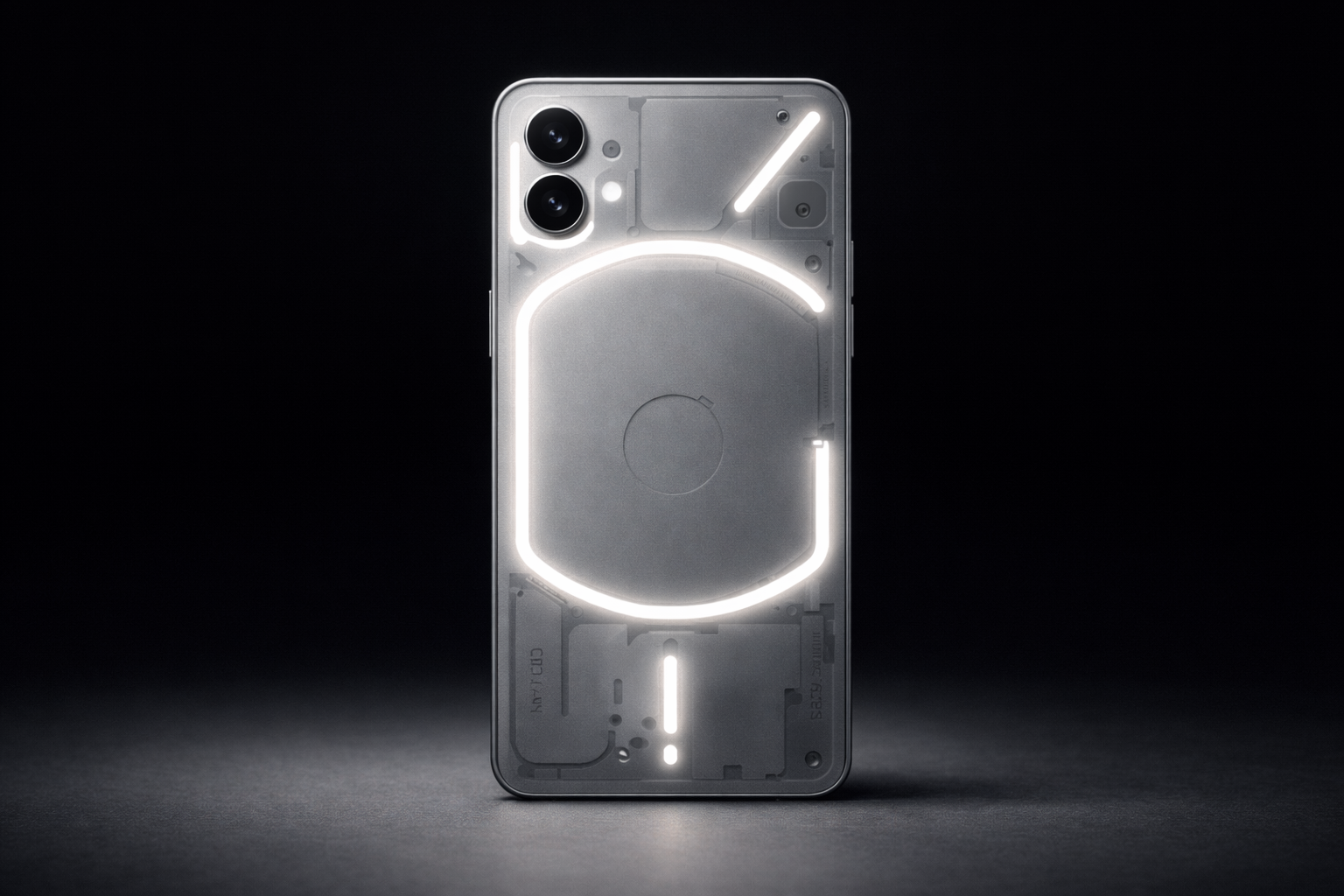
Now, ahead of its March 5 launch event, the company has revealed a redesigned “Glyph Bar” for the upcoming Phone 4A — a move that signals both aesthetic refinement and strategic intent.
Early images and official teasers confirm that the Phone 4A introduces a more consolidated LED layout, shifting from segmented lighting strips to a cleaner bar-style configuration. The Verge’s coverage of the announcement highlights how the updated design emphasizes clarity and functional notification cues rather than decorative symmetry (The Verge – Nothing Phone 4A design reveal).
The adjustment may look subtle at first glance. In practice, it suggests Nothing is recalibrating how light integrates into everyday smartphone interaction.
A Design Language That Refuses to Blend In
Most mid-range smartphones compete quietly. They follow established camera module patterns, conventional glass backs, and muted finishes. Nothing has consistently avoided that path. The Phone 1 and Phone 2 used exposed design elements and programmable LED arrays to create a device that was instantly recognizable across a room.
The Phone 4A appears to refine that philosophy. Rather than scattering LED segments around the camera housing, the new Glyph Bar centralizes light output into a more deliberate visual axis. According to early reporting, the redesign could allow for more precise notification mapping — assigning different light intensities or movement patterns to specific apps and contacts.
GSMArena notes that Nothing has steadily expanded the software customization behind the Glyph Interface in previous releases, allowing users to assign unique patterns for calls and alerts (GSMArena – Nothing Phone 2 review). The Phone 4A’s hardware revision may represent the next logical stage of that evolution.
More Than Aesthetic — A UX Statement
At a time when smartphone differentiation often centers on incremental chipset upgrades or camera sensor tweaks, Nothing’s emphasis on lighting remains unusual. It reframes notifications as ambient signals rather than screen-based interruptions.
The Glyph concept serves a practical purpose:
- Visual call alerts without flipping the phone
- Discrete notification tracking during meetings
- Customizable visual identities for frequent contacts
- Camera fill-light functionality in low-light scenarios
With the Phone 4A, the shift toward a unified bar could simplify user interpretation. Instead of deciphering segmented patterns, users may receive clearer motion-based or brightness-based cues. The Verge suggests that the design is less ornamental and more purposeful this time (The Verge – detailed design breakdown).
That distinction matters. Decorative lighting can feel gimmicky. Functional ambient signaling can feel intentional.
Positioning in a Crowded Mid-Range Market
The Phone 4A enters a competitive segment dominated by performance-per-dollar metrics. Brands like Samsung, Xiaomi, and Google focus heavily on camera capabilities, display brightness, and AI feature integration.
Nothing’s differentiation remains design-first. The company appears less interested in outperforming rivals on benchmark scores and more focused on creating a recognizable ecosystem aesthetic. This strategy carries risk: design-led branding can polarize consumers. Yet it also creates identity in a market where visual sameness is increasingly common.
The timing of the Phone 4A launch is notable. As major manufacturers push deeper into AI-centric narratives — from generative editing to on-device assistants — Nothing continues to invest in physical design language. It suggests confidence that hardware distinctiveness still resonates.
Does the Glyph Concept Have Staying Power?
One of the central questions surrounding Nothing’s approach has always been longevity. Is the Glyph Interface a novelty, or does it represent a meaningful evolution in mobile interaction?
The incremental refinement seen in the Phone 4A hints at long-term commitment rather than experimentation. Instead of abandoning the concept, Nothing is simplifying and clarifying it.
There is a broader implication here. As smartphones become more software-defined — especially with AI layers shaping user experience — tangible hardware identity may regain importance. A distinctive rear lighting system provides physical feedback in a digital era dominated by screen notifications.
If the Phone 4A’s Glyph Bar improves readability and customization while maintaining battery efficiency, it could solidify Nothing’s lighting system as a signature feature rather than a transitional experiment.
Looking Ahead to March 5
Nothing has confirmed that full details will be revealed at its March launch event. Specifications remain under wraps, but the early emphasis on design suggests the company wants the conversation to begin before performance metrics enter the discussion.
That sequencing is deliberate. By revealing the Glyph Bar redesign first, Nothing positions the Phone 4A as an object of design interest — not just a spec sheet entry.
Whether the broader market responds will depend on execution. Mid-range buyers increasingly expect balanced performance, long software support, and competitive camera systems. If the Phone 4A delivers on those fundamentals while strengthening its visual identity, Nothing may carve out a more durable niche.
For now, the Glyph Bar redesign accomplishes something rare in 2026’s smartphone landscape: it makes a mid-range device visually memorable before it even launches.